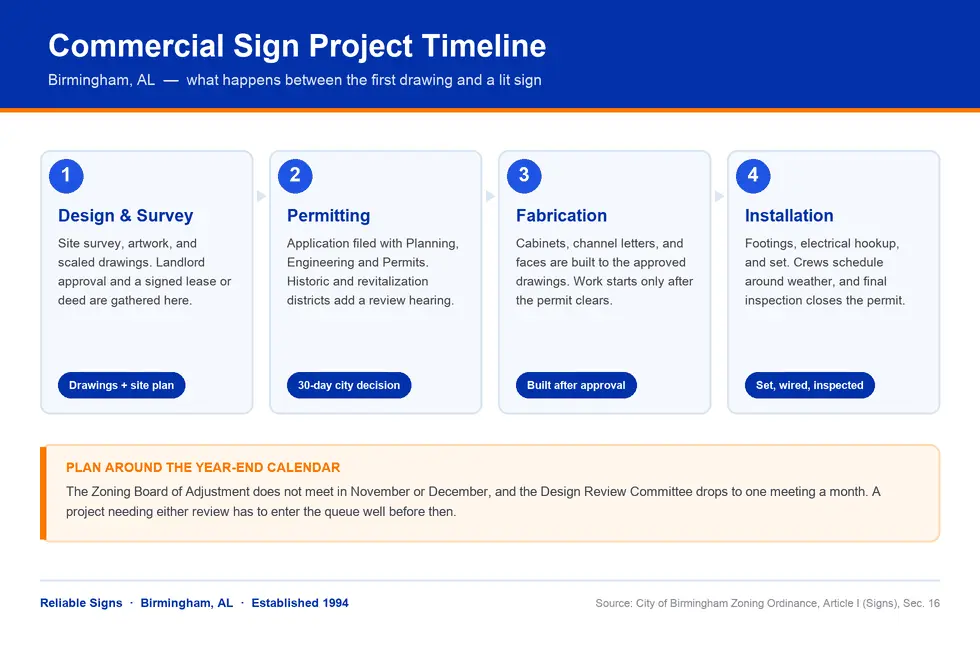
A commercial sign is not a purchase, it is a permitted construction project. Commercial sign installation is the last of four phases that cannot overlap: design and survey, permitting, fabrication, and installation. Each phase hands the next one something it cannot start without.
Only one of those phases has a deadline published in writing. The Birmingham Zoning Ordinance gives the Director or a designee 30 days to approve, deny, or approve with conditions once a completed application and the permit fee are on file. Everything before and after that window depends on your sign type, your site, and how quickly your landlord returns paperwork.
The constraint most owners never see coming is the calendar. Birmingham’s Zoning Board of Adjustment does not meet in November or December. The Design Review Committee, which normally meets the second and fourth Wednesday of each month at 7:30 a.m., drops to a single meeting per month during those two months. If your project needs either body, the queue thins out right when you were counting on it.
Phase One: Design, Survey, And The Paperwork Nobody Budgets For
Design is where most schedules quietly slip, and rarely because of the artwork.
Birmingham requires the permit application to be accompanied by the deed, lease, or other agreement under which the applicant has the right to erect, use, or maintain the sign at that location. For a tenant in a shopping center, that means tracking down an executed lease and, in most cases, written landlord approval of the sign design. Property managers do not always turn that around quickly, and no amount of urgency on the fabrication side moves it faster.
The application also has to state the date on which the sign is to be erected or displayed, along with the zoning district and the Area of Special Aesthetic Concern, if any, that the property sits in. You are committing to a target install date at the moment you apply, which is another reason the survey has to be accurate before anything is filed.
Our design services in Birmingham, AL account for building ordinances, electrical codes, and sign safety at the drawing stage rather than after a plan reviewer sends it back. Catching a height or setback problem in design costs a revision. Catching it after submittal costs a resubmittal.
Phase Two: The Permit And The 30 Day Clock
Applications go to the Department of Planning, Engineering and Permits. The ordinance is specific about what a complete application contains:
- The name, address, and telephone number of the sign contractor and the owner and occupant of the premises
- A drawing site plan to scale showing all existing signs displayed on the premises, plus the location, height, sign type, and size of anything proposed
- Specifications for the construction or display of the sign, and for its illumination and mechanical movement, if any
- Drawings, plans, specifications, and engineering designs sufficient to fully acquaint department personnel with the sign and its location
The existing signs requirement is the one that trips up tenants. Birmingham evaluates the property as a whole. A site plan showing only your new storefront sign, while omitting the center’s pylon and the directory panel already on site, is incomplete. The 30 day clock does not start on an incomplete application.
If the permit is denied, the Director must state the reasons in writing and mail or email them to the address on the application. From there, an applicant may file a written appeal to the Zoning Board of Adjustment. That is a real option, but it is also the branch of the process most exposed to the calendar, because the ZBA meets on the second and fourth Thursday at 3:00 p.m. and does not convene at all in November or December.
We handle sign permitting in Birmingham, AL as part of the project rather than as a document we hand you. For the full breakdown of prohibited sign types, digital display rules, and how neighboring municipalities differ, see our guide to sign permits in Birmingham, AL.
Phase Three: Fabrication
Fabrication begins once the permit is approved. Building to unapproved drawings is a gamble: a conditional approval that changes a cabinet size or an illumination spec turns finished work into scrap.
Duration here depends almost entirely on what you ordered. A flat panel with vinyl graphics and a set of formed channel letters with individual LED modules are not the same build, and a monument with masonry or a steel structure carries footing and engineering work that a wall sign does not. Our sign fabrication in Birmingham, AL is done in house with precision routing and letter forming equipment, which keeps the schedule under our control instead of a third party’s.
Ask your sign company for a fabrication window in writing before you commit to an opening date. Any shop that will not put one in the proposal is telling you something.
Phase Four: Commercial Sign Installation And Final Inspection
Installation is the shortest phase on paper and the one most exposed to conditions outside anyone’s control. Footings have to cure. Electrical has to be run and connected by licensed hands. Crane and aerial lift work gets rescheduled around weather, and Alabama’s late summer storm pattern does not consult your calendar.
Our crews run modern aerial lift trucks for sign installation in Birmingham, AL, which keeps most jobs to a single mobilization rather than a return trip with different equipment.
The project is not finished when the sign lights up. It is finished when the permit is closed out and any conditions attached to the approval have been satisfied. Unaddressed conditions surface at inspection, and an unpermitted or unclosed sign becomes a problem later at resale, at lease renewal, and on a storm damage insurance claim.
Why The Year End Calendar Compresses Everything
Most sign projects in Birmingham never see a committee. A conforming wall sign on a conforming building in a standard commercial district is an administrative review.
The projects that do need discretionary review are the ones where timing matters most, and both review bodies contract at year end:
- Design Review Committee. Meets the second and fourth Wednesday at 7:30 a.m. in Council Chambers. During November and December it operates on a modified holiday schedule and meets only once a month. It reviews signage in Commercial Revitalization Districts and Local Historic Districts.
- Zoning Board of Adjustment. Meets the second and fourth Thursday at 3:00 p.m., except November and December, when it does not meet. This is where variances and permit denials go.
Read those two together and the practical conclusion is straightforward. A project that needs a variance or a design review hearing has to enter the queue with enough runway to clear a hearing, then a 30 day permit decision, then fabrication, then installation. Waiting until late fall to start does not compress that sequence. It pushes the hearing into the new year.
If you are working toward a first quarter opening, a rebrand deadline, or a lease that requires signage by a certain date, the useful exercise is to work backward from that date through all four phases rather than forward from today.
What Actually Adds Weeks
In our experience since 1994, delays cluster around a short list:
- Landlord approval. The lease or deed is a required attachment, and written design approval usually is too. Start this first, not last.
- Incomplete site plans. Omitting existing signage on the property is the most common reason a submission is not treated as complete.
- Engineering added late. Whether sealed drawings are required depends on the structure. Confirm it before shop drawings are finalized.
- Buying the sign before checking the rules. Feather signs, portable signs, inflatable signs, roof signs, and stacked signs are prohibited outright in Birmingham. A purchase order does not create a permit.
- Assuming a Birmingham mailing address means city jurisdiction. Hoover, Vestavia Hills, Homewood, Trussville, and Mountain Brook each run their own process on their own calendar.
Frequently Asked Questions
How long does commercial sign installation take from start to finish?
There is no single answer, because only the permit decision has a published limit of 30 days from a completed application. Design, fabrication, and installation vary by sign type and site. Ask for each phase in writing and add them together rather than accepting one blended estimate.
Can fabrication start while the permit is under review?
It can, but it carries risk. A conditional approval can change dimensions, illumination, or mounting, and anything already built to the original drawing may have to be redone.
Do I need a permit to reface an existing sign?
Confirm it before scheduling the work. Requirements differ by jurisdiction and by whether you are changing the copy or the structure. Some neighboring cities explicitly require a permit for a lettering change tied to a business name change.
What happens if my permit is denied?
The city must give you the reasons in writing. You may file a written appeal with the Zoning Board of Adjustment, which does not meet in November or December, so a late year denial can carry into the following year.
Who do I call at the city?
The Department of Planning, Engineering and Permits can be reached at 205-254-2211. For Design Review Committee questions, the city lists Abraham Odrezin at 205-254-2169.
Start Before The Calendar Decides For You
The sequence is fixed. Design feeds permitting, permitting gates fabrication, and fabrication sets the install date. The only variable you control is when you start.
Reliable Signs has designed, permitted, fabricated, installed, and serviced business signs in Birmingham since 1994, including monument signs and lighted letters. Handling all four phases under one roof is what keeps a handoff from becoming a delay. Contact our team today to map your timeline backward from the date you need the sign lit.